The August 2026 edition of the Overseas Publishing Market Report — Saudi Arabia, written by the correspondent in her role as Saudi Arabia Export Coordinator at the Publication Industry Promotion Agency of Korea (KPIPA). Published as part of KPIPA's Global Publishing Trends Report series, it surveys the major book fairs and literary awards of Saudi Arabia and the GCC (Gulf Cooperation Council) and wider Arab world, and considers the prospects for Korean publishing content there.
Contents
1
Book Fairs in Saudi Arabia and the GCC/Arab World
Major book fairs in Saudi Arabia and exchange with Korea · Major book fairs in the GCC/Arab world and prospects for Korean publishing content
2
Literary Awards in Saudi Arabia and the GCC/Arab World
Major literary awards in Saudi Arabia and their industry character · Major literary awards in the GCC/Arab world and their links to translation and publishing
3
Overall Implications and Entry Strategies for Korean Publishers
Findings across book fairs and literary awards · Entry-strategy recommendations for Korean publishers
The full report follows below. To read the original as published, use "Download the full report" above — note that the downloadable PDF is available in Korean only.
Book Fairs and Literary Awards in Saudi Arabia and the GCC/Arab World
Saudi Arabia's publishing market is closely tied to the GCC (Gulf Cooperation Council) and the wider Arab world in language, distribution, and rights trading. Arabic-language publications circulate through a regional market rather than staying confined to any one country, and major book fairs and literary awards function as key channels for cross-border exchange in publishing, translation, and rights. This report accordingly focuses on Saudi Arabia's major book fairs and literary awards, while also surveying and comparing key cases from the GCC and the wider Arab world to place Saudi Arabia's publishing market in a fuller regional context and to gauge the prospects for Korean publishing content there.
Major Book Fairs in Saudi Arabia and Exchange with Korea
In Saudi Arabia, large-scale book fairs are held mainly in the capital Riyadh and in Jeddah in the west, and book events have recently been expanding to Madinah and the Eastern Province as well. The Literature, Publishing and Translation Commission (LPT), under the Ministry of Culture, runs these fairs not only as venues connecting publishers with readers but as platforms for invigorating the publishing industry and fostering cultural exchange at home and abroad. Separately, the King Abdulaziz Center for World Culture (Ithra) in Dhahran holds an annual book fair devoted to children's literature.
Table 1 — Major Book Fairs in Saudi Arabia
| Book Fair | City | Founded | 2026 Dates | Features (Keywords) |
|---|
| Riyadh International Book Fair (RIBF) | Riyadh | 1978 | Oct (date TBD) | Saudi Arabia's largest international book fair; 2026 Guest of Honor Syria; publishing/rights business functions |
| Jeddah International Book Fair (JIBF) | Jeddah | 2015 | Dec expected (date TBD) | Major Saudi fair; leading western-region book exhibition/sales and cultural programming |
| Ithra Children's Book Fair | Dhahran | 2021 | Jul 20–25 (held) | Specialist fair for ages 4–14; Korea Guest of Honor 2025, Syria Guest of Honor 2026 |
The Riyadh International Book Fair is Saudi Arabia's largest international book fair. It began in 1978 at what was then Riyadh University (now King Saud University) and is now organised by the LPT. The 2025 edition was held at Princess Nourah bint Abdulrahman University and drew more than 2,000 publishers and agencies from over 25 countries. Alongside book exhibitions and sales for general readers, it runs business programmes for rights, licensing, and exchange among publishing agencies, making it a key international-exchange channel for the Saudi publishing industry. The 2026 edition is scheduled for October, with Syria selected as Guest of Honor.
The Jeddah Book Fair is the leading large-scale book fair in western Saudi Arabia. The 2025 edition ran from 11 to 20 December at the Jeddah Superdome, drawing more than 1,000 domestic and international publishers and agencies from 24 countries across roughly 400 booths. Alongside book exhibition and sales, it runs seminars, panels, workshops, and children's programming, giving it a strong character as a cultural event for general readers and families. As of August 2026, no official date has been announced for the 2026 edition.
The Ithra Children's Book Fair is a fair for children and young readers held by the King Abdulaziz Center for World Culture in Dhahran. It is especially notable for its documented points of contact with the Korean publishing market. At its 5th edition in 2025, Korea was selected as Guest of Honor, with a special exhibition introducing Korean children's literature. Notably, illustrator Han Dam-hee's picture book Star Papa (별 아저씨) — winner of the 2025 BolognaRagazzi CrossMedia Award — was translated into Arabic and published, introducing it to local readers. Han also took part in person, running a children's workshop on making mini-books and traditional Korean fans.
The LPT also runs the Madinah Book Fair and the Eastern Region Book Fair, among others, to build reading culture and expand the publishing ecosystem at a regional level. These are more regional in character than the large fairs in Riyadh and Jeddah, but they matter for widening the base where publishers and readers can meet beyond the capital and major cities.
Exchange and Participation with Korea
Saudi Arabia took part as Guest of Honor at the 2024 Seoul International Book Fair, introducing Saudi literature and publishing content to Korea, and the following year, as noted above, Korea served as Guest of Honor at the Ithra Children's Book Fair in 2025. This continues a pattern of two-way exchange — Saudi content introduced in Korea, and Korean children's literature introduced in Saudi Arabia.
For Korean publishers, the Riyadh International Book Fair's rights, licensing, and publishing-business programming can serve as a channel for building networks with local publishers and industry contacts and for entering the Arabic-language market. The Ithra Children's Book Fair, having already engaged with Korea in 2025, also offers a concrete point of cooperation for bringing Korean picture books and children's/YA publishing content into Saudi Arabia.
Sources — Literature, Publishing and Translation Commission (LPT), Ministry of Culture of Saudi Arabia, materials on major Saudi book fairs, as of August 2026, lpt.moc.gov.sa · Saudi Press Agency (SPA), on Syria as Guest of Honor at the 2026 Riyadh International Book Fair and on Saudi Arabia's 2024 pavilion as Guest of Honor at the Seoul International Book Fair, spa.gov.sa
Major Book Fairs in the GCC/Arab World and Prospects for Korean Publishing Content
International book fairs of various sizes are held across the GCC and the wider Arab world. Considering event scale, international-publisher participation, influence within the publishing market, and translation/rights-exchange functions, this report selected six major fairs: five in the GCC — Sharjah, Doha, Abu Dhabi, Kuwait, and Muscat — plus, outside the GCC, the Cairo International Book Fair in Egypt, which commands a large publishing market and readership.
Table 2 — Major Book Fairs in the GCC and Arab World
| Book Fair | City | Founded | 2026 Dates | Features (Keywords) |
|---|
| Cairo International Book Fair (CIBF) | Cairo, Egypt | 1969 | 21 Jan–3 Feb (held) | Leading large-scale Arab-world fair; 2026 drew 1,457 publishers from 83 countries, 6,637 exhibitors |
| Sharjah International Book Fair (SIBF) | Sharjah, UAE | 1982 | 4–15 Nov | World-scale international fair; publishing-professional and translation-grant programming; 2026 Guest of Honor Oman |
| Doha International Book Fair (DIBF) | Doha, Qatar | 1972 | 14–23 May (held) | Major GCC fair; 2026 drew 520 publishers from 37 countries across 910 booths |
| Abu Dhabi International Book Fair (ADIBF) | Abu Dhabi, UAE | 1981 | 13–18 Sep | Rights/licensing B2B focus; names a "Person of the Year" annually |
| Kuwait International Book Fair (KIBF) | Kuwait City | 1975 | 2026 dates not announced | One of the Arab world's long-running fairs; domestic/international publishers; children's/YA and cultural programming |
| Muscat International Book Fair (MIBF) | Muscat, Oman | 1992 | Postponed (originally 26 Mar–5 Apr) | Oman's leading international fair; 30th edition postponed due to regional conditions, new dates not announced |
The Cairo International Book Fair (CIBF), launched in 1969, is a leading large-scale fair in the Arab world. Its 57th edition in 2026 ran from 21 January to 3 February, drawing 1,457 publishers and 6,637 exhibitors from 83 countries. The 2026 edition also drew more than 6.2 million visitors, underscoring CIBF's influence as a fair built on a mass readership. Beyond book exhibition and sales for general readers, it hosts large-scale author events, seminars, and cultural programming, making it a key event for tracking the Arabic-language publishing market and reader trends.
The Sharjah International Book Fair (SIBF), launched in 1982 on the initiative of Sharjah's ruler Sheikh Sultan bin Muhammad Al Qasimi, is run by the Sharjah Book Authority (SBA). It combines a large general readership with dedicated publishing-professional programming that draws international publishers and agents. Its translation-grant programme, supporting both the translation of Arabic books abroad and the translation of foreign books into Arabic, gives it particularly strong international publishing/translation-exchange functions. The 45th edition in 2026 will run from 4 to 15 November, with Oman selected as Guest of Honor.
The Doha International Book Fair (DIBF), launched in 1972, is Qatar's leading international book fair. Initially biennial, it has been held annually since 2002. The 35th edition in 2026 ran from 14 to 23 May, with 520 publishers from 37 countries participating across 910 booths. Alongside book exhibition and sales, it runs new-release launches, seminars, panels, and workshops, functioning as a major publishing and cultural platform for Qatar.
The Abu Dhabi International Book Fair (ADIBF), launched in 1981, is now organised by the Abu Dhabi Arabic Language Centre (ALC). It is a fair with particularly strong B2B functions around rights and licensing deals and networking among publishing professionals, and it also runs programmes supporting translation and international rights transactions. This makes it a key platform for foreign publishers to build business networks with Arab-world publishers and agents. The 35th edition in 2026 will run from 13 to 18 September.
The Kuwait International Book Fair (KIBF), launched in 1975, is a long-running fair organised by Kuwait's National Council for Culture, Arts and Letters (NCCAL). Alongside book exhibition and sales by domestic and international publishers, it runs author events, talks, and children's/youth programming. It is notable for the weight it gives to programming aimed at families and younger readers. As of this report, no official date has been announced for the 2026 edition.
The Muscat International Book Fair (MIBF), launched in 1992, is Oman's leading international book fair, combining book exhibition and sales by domestic and international publishers with a range of literary and cultural programming, and has become a major cultural event in Oman. The 30th edition in 2026 was originally scheduled for 26 March to 5 April but was postponed due to regional conditions; as of August 2026, no new date has been announced.
Exchange and Participation with Korea
The most notable case of exchange between Korea and GCC-region book fairs is the Sharjah International Book Fair. Korea took part as Guest of Honor at the 42nd Sharjah International Book Fair in 2023, presenting an intensive introduction to Korean literature and publishing content. The programme included a special exhibition of Korean literature, a picture-book exhibition, book talks with Korean authors, and roundtables between Korean and UAE publishing professionals, alongside programming introducing Korean culture more broadly, including music and hanbok.
Notably, Sharjah reciprocated the same year, taking part as Guest of Honor at the 2023 Seoul International Book Fair. With Sharjah introducing its own literature and publishing culture in Korea, followed by Korea's participation as Guest of Honor in Sharjah, the two sides achieved a genuinely mutual exchange of publishing content and culture through each other's flagship book fairs.
At the 2024 Abu Dhabi International Book Fair, the Korean Cultural Center in the UAE co-organised a Korean Culture Conference with local cultural institutions. Local publishing and content-industry figures took part, discussing the international spread of Korean culture and the prospects for introducing Korean literature in the Middle East.
A recent example of exchange in the other direction is Oman's participation in the 2024 Seoul International Book Fair. Oman took part as "Spotlight Country" at the 2024 Seoul International Book Fair, running literature and publishing exchange programming to mark the 50th anniversary of Korea–Oman diplomatic relations. This shows that publishing exchange between Korea and the Gulf region extends beyond the UAE to other GCC countries as well.
Taken together, these cases show that the UAE currently has a relatively concrete foundation for cooperation in publishing exchange between Korea and the GCC/Arab world. Sharjah in particular offers points of contact for publishing and translation exchange through reciprocal Guest-of-Honor participation and its translation-grant programme, while Abu Dhabi's strong B2B functions around rights and licensing can be used to build networks for Korean publishers entering the Arabic-language market. At the same time, a mass-readership fair such as Cairo offers a different kind of value, functioning as a channel for reading the Arabic-language reader market and publishing trends.
Sources — Egypt's State Information Service (SIS), on the 57th Cairo International Book Fair, as of August 2026 · Sharjah Book Authority (SBA); Doha International Book Fair (DIBF); Abu Dhabi International Book Fair (ADIBF); Kuwait's National Council for Culture, Arts and Letters (NCCAL); Oman News Agency (ONA) — official materials, as of August 2026 · Korea.net (2023); Oman Ministry of Foreign Affairs (2024)
Major Literary Awards in Saudi Arabia and Their Industry Character
Table 3 — Literary Awards in Saudi Arabia
| Award | Established | Features |
|---|
| King Faisal Prize – Arabic Language and Literature (KFP) | Established 1977, first awarded 1979 | Saudi Arabia's leading international academic/cultural prize; 5 categories; Arabic Language & Literature sets a new theme each year |
| National Cultural Awards – Literature/Translation/Publishing | Launched 2020 | National cultural award run by the Ministry of Culture; literature, translation, and publishing each an independent category |
| Golden Pen Award | Launched 2024 | Total prize pool of $740,000; recognises popular fiction, translation, and publishing; winners linked to film adaptation; run by the General Entertainment Authority (GEA) |
Among the literary and publishing awards operating in Saudi Arabia, this report selected the King Faisal Prize, the National Cultural Awards, and the Golden Pen Award as key cases, based on national standing and their ties to the literature and publishing industries. The three awards each represent a different character — academic/literary achievement, national cultural policy, and the link between popular literature and the screen industry, respectively.
The King Faisal Prize (KFP), run by the King Faisal Foundation, is Saudi Arabia's leading international academic and cultural award. Established in 1977 and first awarded in 1979, it comprises five categories: Service to Islam, Islamic Studies, Arabic Language and Literature, Medicine, and Science. Within this, the Arabic Language and Literature category sets a specific research theme each year and honours individuals or institutions with outstanding academic or cultural achievement in that field. No winner meeting the selection criteria was named in 2024 or 2025; in 2026, under the theme "Arabic Literature in French," the prize went to Professor Pierre Larcher of France.
The National Cultural Awards are a comprehensive cultural award run by Saudi Arabia's Ministry of Culture as part of national cultural strategy and Vision 2030. Minister of Culture Prince Badr bin Abdullah bin Farhan announced the award's introduction in 2019, and the programme officially launched in 2020. It initially centred on awards across cultural fields including literature, publishing, and translation, and its categories have since expanded. The 6th National Cultural Awards in 2026 comprise 7 major awards and 12 category awards, with the Literature Award, Publishing Award, and Translation Award each an independent category. Rather than functioning as a conventional literary prize honouring a single work, it is more oriented toward identifying and recognising, at a national level, individuals and institutions with achievements across Saudi cultural fields. At the 4th edition in 2024, for example, novelist Osamah Al-Muslim won the Literature Award, children's specialist publisher Qyadiya Publishing House won the Publishing Award, and Walid Al-Omari won the Translation Award.
The Golden Pen Award, launched in 2024 by Saudi Arabia's General Entertainment Authority (GEA), centres on Arabic-language fiction and story IP. Unlike conventional literary prizes, it is distinguished by its focus on identifying novels and screenplays with strong popular and cinematic potential, connecting publishing content to the screen industry. Its fiction category is broken down into eight genres — thriller, mystery/crime, romance, fantasy, comedy, historical, horror, and realism — alongside awards for screenplays adapted from literary works, best translated novel, best Arab publisher, and a readers' choice award.
According to official figures, the total prize pool is $740,000. First place in fiction receives $100,000 along with a film-production opportunity; second place receives $50,000, also with film production; each genre award carries $25,000. Best translated novel receives $100,000, and best Arab publisher receives $50,000. The Golden Pen Award thus links literary creation with the film adaptation, translation, and publication of novel IP within a single industrial structure, making it a case that illustrates recent shifts in Saudi Arabia's content industry.
Features from a Publishing-Market Perspective
The three awards represent different axes of Saudi Arabia's literary and publishing policy: the King Faisal Prize centres on international academic authority in Arabic and literature; the National Cultural Awards, on national-level support for and recognition of the literature, publishing, and translation ecosystem; and the Golden Pen Award, on popularising literary IP and expanding into the screen industry.
From a publishing-market perspective, it is notable that the National Cultural Awards recognise publishing and translation as separate categories alongside literature, and that the Golden Pen Award honours not only authors but translated novels and Arab publishers, directly linking novels to film adaptation. This points to an emerging trend in Saudi Arabia of connecting literature to other content industries — publishing, translation, film — rather than treating it as a purely independent art form.
Sources — King Faisal Prize, official site, kingfaisalprize.org, as of August 2026 · Saudi Press Agency (SPA), on the launch of the 6th National Cultural Awards, 1 March 2026 · Riyadh Review of Books, on the Golden Pen Award
Major Literary Awards in the GCC/Arab World and Their Links to Translation and Publishing
Among the literary and publishing awards operating across the GCC and the wider Arab world, this report selected six major awards based on international standing, prize scale, and links to translation, publishing, and international outreach: the International Prize for Arabic Fiction (IPAF), the Sheikh Zayed Book Award, the Katara Prize for Arabic Novel, the Naguib Mahfouz Medal for Literature, the Turjuman Award, and the Sheikh Hamad Award for Translation and International Understanding — covering not only literary creation but also translation, publishing, and international distribution.
Table 4 — Major Literary Awards in the GCC and Arab World
| Award | Established | Features |
|---|
| International Prize for Arabic Fiction (IPAF) | Launched 2007, first awarded 2008 | Leading international award for Arabic fiction; backed by the ALC; supports translation/publication abroad |
| Sheikh Zayed Book Award (SZBA) | Established 2006 | 10 categories including literature, translation, publishing; total prize pool of 7.75M AED |
| Katara Prize for Arabic Novel | Established 2014 | Supports the writing and publication of Arabic novels; 2026 total prize pool $375,000; linked to translation |
| Naguib Mahfouz Medal for Literature | Established 1996 | Awarded for contemporary Arabic fiction; winners linked to English translation and publication abroad |
| Turjuman Award | Established 2016 | Supports foreign-language translation and publication of Arabic books; for translators and publishers; run by the SBA |
| Sheikh Hamad Award for Translation and International Understanding | Established 2015 | Qatar's international translation award; supports two-way Arabic↔foreign-language translation |
The International Prize for Arabic Fiction (IPAF), launched in 2007 and first awarded in 2008, is a leading international award for Arabic-language fiction. It is currently backed by the Abu Dhabi Arabic Language Centre (ALC) and run by an independent board. Each of the six shortlisted finalists receives $10,000, and the eventual winner receives a further $50,000. It is distinguished by supporting English translation of the winning work and encouraging translation into other languages as well, helping Arabic fiction reach the international publishing market.
The Sheikh Zayed Book Award (SZBA), established in 2006, is Abu Dhabi's leading comprehensive cultural and book award, now run by the Abu Dhabi Arabic Language Centre. It covers 10 categories including literature, translation, children's literature, and publishing and technology, with a total prize pool of 7.75 million AED. It is notable for supporting literary creation together with the translation and publishing industries, covering not just authors but translators and publishers/cultural institutions as well.
The Katara Prize for Arabic Novel, established in 2014 by Qatar's Katara Cultural Village Foundation, is an award for Arabic-language fiction. As of 2026 its total prize pool is $375,000, and it runs several categories including published novels, unpublished novels, and children's fiction. It also supports the international spread of Arabic fiction by linking winning works to translation and publication. The 12th edition in 2026 received a record 2,610 submissions, comprising 1,488 unpublished novels, 578 works published in 2025, and 303 unpublished children's novels, among others.
The Naguib Mahfouz Medal for Literature was established in 1996 by the American University in Cairo (AUC) Press. It is awarded to contemporary Arabic novels not yet translated into English, with winners receiving prize money along with English translation and publication abroad. Its significance lies less in the size of the prize than in its role connecting Arabic-language works to the English-language publishing market.
The Turjuman Award, established in 2016 by the Sharjah Book Authority (SBA), is a translation-and-publishing award. It supports the foreign-language translation and international publication of works originally published in Arabic, covering not only translators but also the original and international publishers involved, with the aim of promoting the international market entry of Arabic-language publications.
The Sheikh Hamad Award for Translation and International Understanding, established in Qatar in 2015, is an international translation award. It is distinguished by its two-way structure, covering translation from Arabic into foreign languages as well as from foreign languages into Arabic — giving it the character of an international translation exchange that serves both the international reach of Arabic literature and the introduction of foreign literature into the Arabic-speaking world.
Sources — International Prize for Arabic Fiction (IPAF), official site, arabicfiction.org, as of August 2026 · Sheikh Zayed Book Award (SZBA), zayedaward.ae · American University in Cairo (AUC) Press, on the Naguib Mahfouz Medal for Literature · Sharjah Book Authority (SBA), on the Turjuman Award · Sheikh Hamad Award for Translation and International Understanding, hta.qa · The Peninsula, "record submissions for the 12th Katara Prize for Arabic Novel," 2026
Overall Implications and Entry Strategies for Korean Publishers
On the book-fair side, this report surveyed nine fairs in total: Saudi Arabia's Riyadh and Jeddah international book fairs and the Ithra Children's Book Fair, plus the Cairo, Sharjah, Doha, Abu Dhabi, Kuwait, and Muscat international book fairs across the GCC and wider Arab world. The fairs differ not only in scale but in function. Cairo is a leading Arab-world fair built on a mass general readership; Sharjah stands out for international publishing and translation exchange; and Abu Dhabi stands out for rights/licensing and B2B networking among publishing professionals. The Riyadh International Book Fair, Saudi Arabia's largest, has also been expanding its publishing-business programming in recent years.
Korean publishing content's entry into the Arab world would also benefit from approaching book fairs differently depending on the goal. Abu Dhabi and Sharjah can serve as key points of contact for rights export and identifying local publishers and agents, while Cairo and Riyadh, with their mass readerships, can help raise awareness of specific titles among general readers. Korea benefits in particular from an existing foundation of exchange, having taken part as Guest of Honor at the 2023 Sharjah International Book Fair the same year that Sharjah reciprocated as Guest of Honor at the Seoul International Book Fair.
On the awards side, this report surveyed nine awards in total — three in Saudi Arabia and six across the GCC/Arab world. These awards show a structure that extends beyond honouring literary creation to linking translation, publishing, and international distribution. IPAF and the Naguib Mahfouz Medal support the translation and publication of Arabic-language works abroad; the Turjuman Award encourages foreign-language translation and international publication of Arabic books; the Sheikh Zayed Book Award runs translation and publishing as independent award categories; and the Katara Prize for Arabic Novel likewise links winning works to translation and publication.
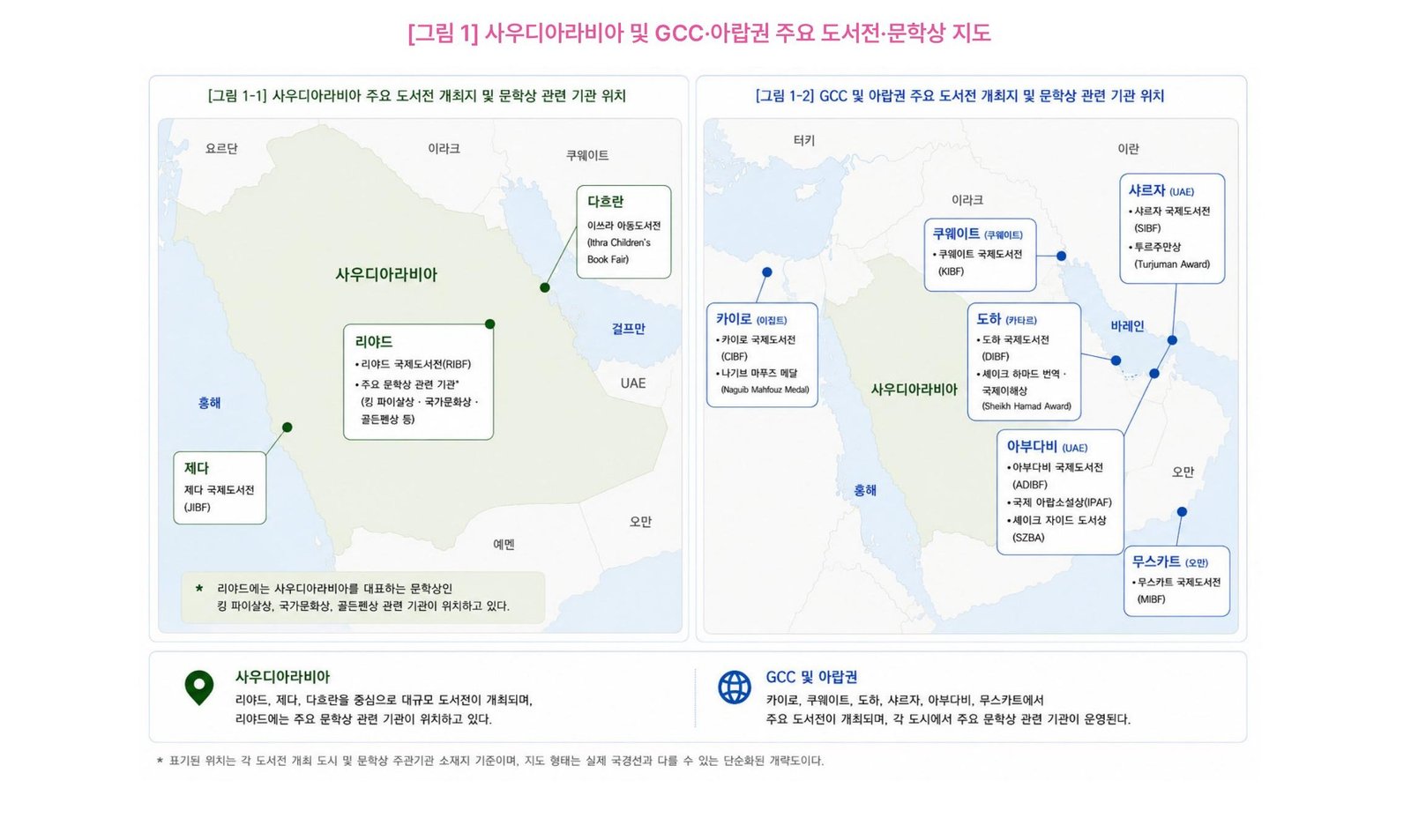
▲ [Figure 1] Map of major book fairs and literary awards in Saudi Arabia and the GCC/Arab world. Locations shown are based on each fair's host city or the location of the relevant award's administering institution; the map is a simplified schematic that may not reflect actual borders. — Source: prepared by the correspondent
The operating structure of the Sheikh Hamad Award for Translation and International Understanding is especially worth noting for its relevance to Korean publishing content. Where the Turjuman Award mainly supports translation of Arabic books into foreign languages, the Sheikh Hamad Award covers two-way translation, Arabic↔foreign language. This structure is meaningful in that it opens a way to explore future two-way publishing exchange — Korean literature translated into Arabic, and Arabic literature translated into Korean.
In Saudi Arabia, the recent link between literature and other content industries is increasingly pronounced. The National Cultural Awards run literature, translation, and publishing as independent categories, and the Golden Pen Award links its awards for fiction, translation, and publishing directly to film production for some winning works. This reflects a strengthening industrial approach that treats literary works not merely as publications but as IP that can extend into film and screen content.
Taken together, Korean publishers' entry into the Saudi and GCC markets can expand beyond simply introducing finished Korean books to local readers — toward rights deals with local publishers, Arabic translation and local publication of Korean literature, Korean translation and publication of Arabic literature, co-publishing and author exchange, and the screen adaptation of literary IP. In particular, by drawing on Sharjah's and Abu Dhabi's existing publishing and translation networks together with Saudi Arabia's expanding support policies for the publishing and content industries, Korean publishers could develop this beyond simple content export into genuine two-way publishing and cultural exchange between Korea and the Arab world.
Publication Details
— Published by the Publication Industry Promotion Agency of Korea (KPIPA) · 31 August 2026
— Series: Global Publishing Trends Report — Overseas Publishing Market Report
— Source: kpipa.or.kr